What the literature says about each sound modality
Educational content: what was studied and what wasn't about the sound modalities Tonaleve includes —broadband, notched, AM modulation, and CR sequence—, with the labels you'll see in the app and no marketing.
Last reviewed: August 2026
Before you start. This page is educational material, not a description of what Tonaleve does for you. Tonaleve is a general wellness product: it generates personalized sound to help you relax, sleep, and mask. It is not a medical device, it doesn’t diagnose or treat any condition, and we don’t promise any health outcome. We publish this because we believe you have the right to know what was studied and what wasn’t before you listen to anything.
The framework: what the literature says
The honest framing set by international guidelines:
- There is no proven cure today nor a consistent method to “turn down the volume” of chronic tinnitus. This is established by the American Academy of Otolaryngology–Head and Neck Surgery guideline (Tunkel et al., AAO-HNS 2014), the British guideline NICE NG155 (2020), and the European multidisciplinary guideline (Cima et al., HNO 2019).
- What the literature supports best is working on the reaction to tinnitus —distress, attention, sleep— not eliminating it. The intervention with the strongest support is cognitive behavioral therapy (CBT), done with a professional: the Cochrane review by Fuller et al. (2020) found a mean improvement of −10.9 THI points versus control.
- Structured counseling alone also shows an effect: in the TRTT trial (Scherer & Formby, JAMA Otolaryngology 2019), ~40% of participants responded to standardized counseling.
- The good underlying news: most people habituate — the nervous system learns to filter the signal. The typical process takes between 2 and 18 months.
And sound? The Cochrane review by Sereda et al. (2018) rates it as inconclusive evidence as a standalone treatment: neither proven nor ruled out. That’s why serious programs —like the Progressive Tinnitus Management program from the US veterans health system (Henry et al., 2022)— use sound as a tool within a process of education and support, not as a magic bullet. Tonaleve builds on that same idea —personalized sound plus educational content—, without promising any outcome.
Our honesty rule
Each modality carries its own visible label in the app. We don’t sell promises: we tell you which one is widely used, which one has been studied little, and which one is early research. Personalization —centering the sound on your reference tone— is a necessary condition for several of these techniques, and it’s what almost no app does with a serious protocol.
| Modality | Label in the app | What it’s used for |
|---|---|---|
| Broadband sound enrichment | Widely used | Sleeping, background sound, lowering contrast with silence |
| Notched sound | Little studied — try it and log it | Personal test against your tone, with your own data |
| AM 10 Hz modulated tone | Emerging | Short listening sessions |
| CR/ACRN sequence | Experimental — no consolidated support | Only as informed exploration |
1. Broadband sound enrichment — the most used
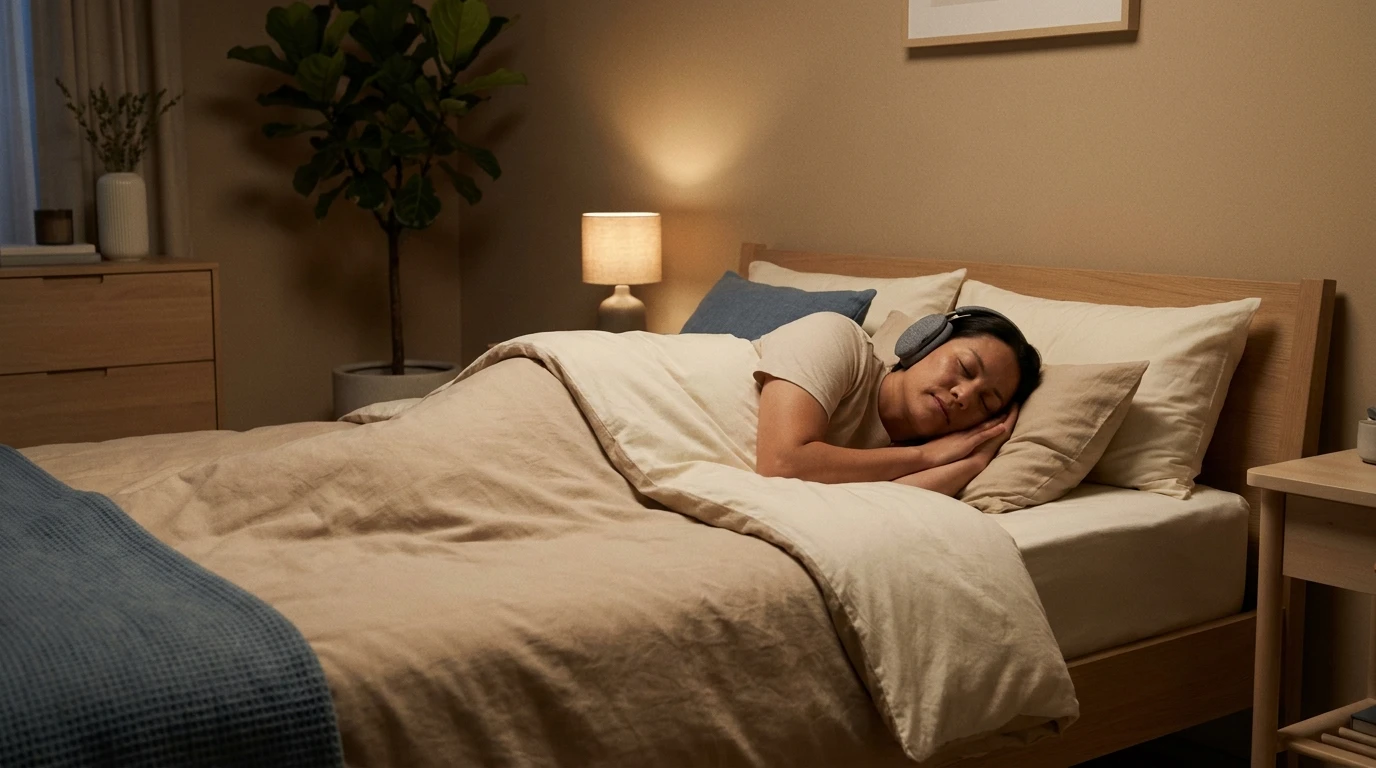
Soft broadband noise (pink or white) used as background sound, especially at night: absolute silence maximizes the contrast with the tinnitus and its perceived prominence. This is the technique that guidelines and PTM-type programs cover: it doesn’t claim to treat anything, it just takes the spotlight off silence. In Tonaleve the level is set in dB SL relative to your sound profile and respects the mixing point principle (the level that blends with the tinnitus without fully masking it).
2. Notched sound — little studied, an honest experiment
Notched sound (Tailor-Made Notched Music Training) filters a ½-octave notch centered on your reference tone out of the audio you listen to. The hypothesis: lateral inhibition in the auditory cortex around the “empty” frequency would reduce, over time, the activity associated with tinnitus.
What the evidence says, with no embellishment:
- Teismann et al. (PLoS ONE 2011) — the only study stratified by frequency — found an effect only in tinnitus ≤ 8 kHz, not above.
- The large RCTs were negative on their primary outcome: Stein et al. (BMC Neurology 2016) and Atipas et al. (2021).
- Recent meta-analyses (Eur Arch ORL 2024; Jiang 2025) suggest, at most, small effects.
- Wunderlich et al. (PLoS ONE 2015) established the ½-octave notch width as the optimal parameter — the one Tonaleve uses.
- Context worth knowing: Tinnitracks, the German notched-sound app, was removed from the DiGA directory (reimbursable medical apps) for not proving efficacy.
Why we offer it anyway: it’s cheap, safe at controlled levels, and —unlike almost any other intervention— individually measurable. Tonaleve frames it as a personal experiment with data: defined multi-week blocks, logged listening time, and your evolution (tone, level, annoyance) charted. If it doesn’t move the needle in your case, you’ll see it in your own data — and the app will tell you.
3. Amplitude-modulated tone (AM 10 Hz) — emerging
A tone at your reference tone, amplitude-modulated at ~10 Hz. Work by Neff et al. (2017, 2019) showed that modulated tones produce more transient suppression (residual inhibition) than pure tones, with active research lines on AM enrichment (Hearing Research, 2025). Sendesen (2024) proposes residual inhibition as a predictor of response. This is emerging evidence: material for short listening sessions, not an established intervention.
4. CR / ACRN sequence — experimental
Acoustic Coordinated Reset Neuromodulation (Tass et al., 2012) alternates four tones around your reference tone (ratios 0.766–1.4) aiming to “desynchronize” neuronal activity. The original study was promising, but the replication trial RESET2 was inconclusive and later reviews (Wegger et al., 2017) maintain the verdict of unreplicated evidence. In Tonaleve it’s labeled as experimental: available for anyone who wants to explore it informed, never as a promise.
The cutting-edge context: bimodal neuromodulation
To place the state of the art: the Lenire device (bimodal sound + tongue stimulation) published results in Science Translational Medicine (Conlon et al., 2020) and Nature Communications (TENT-A3, 2024), and obtained FDA De Novo authorization in 2023. The research line by Susan Shore (JAMA Network Open, 2023) points in the same somatosensory direction. These are regulated medical devices, costing hundreds to thousands of dollars — Tonaleve doesn’t compete with that or simulate it: we tell you so you have the full picture.
What the evidence ruled out
Just as important as knowing what to try is knowing what not to spend money on:
- Ginkgo biloba — no effect (Cochrane review, 2022).
- Zinc — no effect (Cochrane, 2016).
- Betahistine — no effect for tinnitus (Cochrane, 2018).
- “Miracle” supplements like Tinnitus 911: no evidence and a history of complaints.
Honest summary
- Profile it — a carefully built sound profile is the basis for any personalization (how it works).
- Use sound — broadband + educational content + habits: the most widespread and the easiest to sustain.
- Experiment with data — notched and AM as personal, logged trials, with expectations stated up front (a small or null effect is the most likely outcome; if something shows up, your data will show it).
- Consult — diagnosis and warning-sign cases are always a healthcare professional’s territory (safety).
All citations on this page, with links, in Sources and bibliography.