How to Build a Sound Environment for Sleep
Before you pick a background sound for sleep, it helps to notice which noises actually reach your bedroom and when. Here's how to build that environment, step by step.
Last reviewed: September 7, 2026

Building a good sound environment for sleep isn’t about picking the nicest sound off a list. It’s a handful of small decisions, shaped by your room and your schedule. None of them is complicated on its own, but the order you make them in matters.
Start by Listening to What Actually Reaches Your Room
Before you choose anything, it’s worth spending one night just paying attention instead of trying to fix it right away. What can you hear from your bed? It might be traffic from the avenue next door, the elevator door slamming two floors down, a neighbor coming home late, the refrigerator kicking on every so often in the kitchen. Each of those noises has its own pattern: it shows up at a certain hour, lasts a while, and fades, or it’s steady from the moment you lie down until you fall asleep. That pattern is the piece of information you need before building any sound environment, because the background you pick is chosen against that specific noise, not against noise in general. Masking a steady appliance hum calls for something different than covering a single spike of noise that only shows up once, at 3 a.m., when the last bus goes by.
A Steady Background Beats One Full of Moments
It’s tempting to reach for something pretty to fall asleep to: a playlist of waves crashing, birdsong at dawn, rain with the occasional distant thunder. The problem is exactly what makes those tracks appealing in the first place — they have moments. Every time a wave breaks louder than the last one, or a bird calls out after a stretch of quiet, your ear registers it as something new and pulls your attention back, even if only for a second. For falling asleep, a steady background sound with no surprises works better than one full of variation, however pleasant that variation might be at another point in the day. The goal isn’t for it to sound beautiful the first time you really listen to it — it’s for it to stop being noticeable after five minutes.
Speaker or Headphones, Depending on Who You Share the Room With
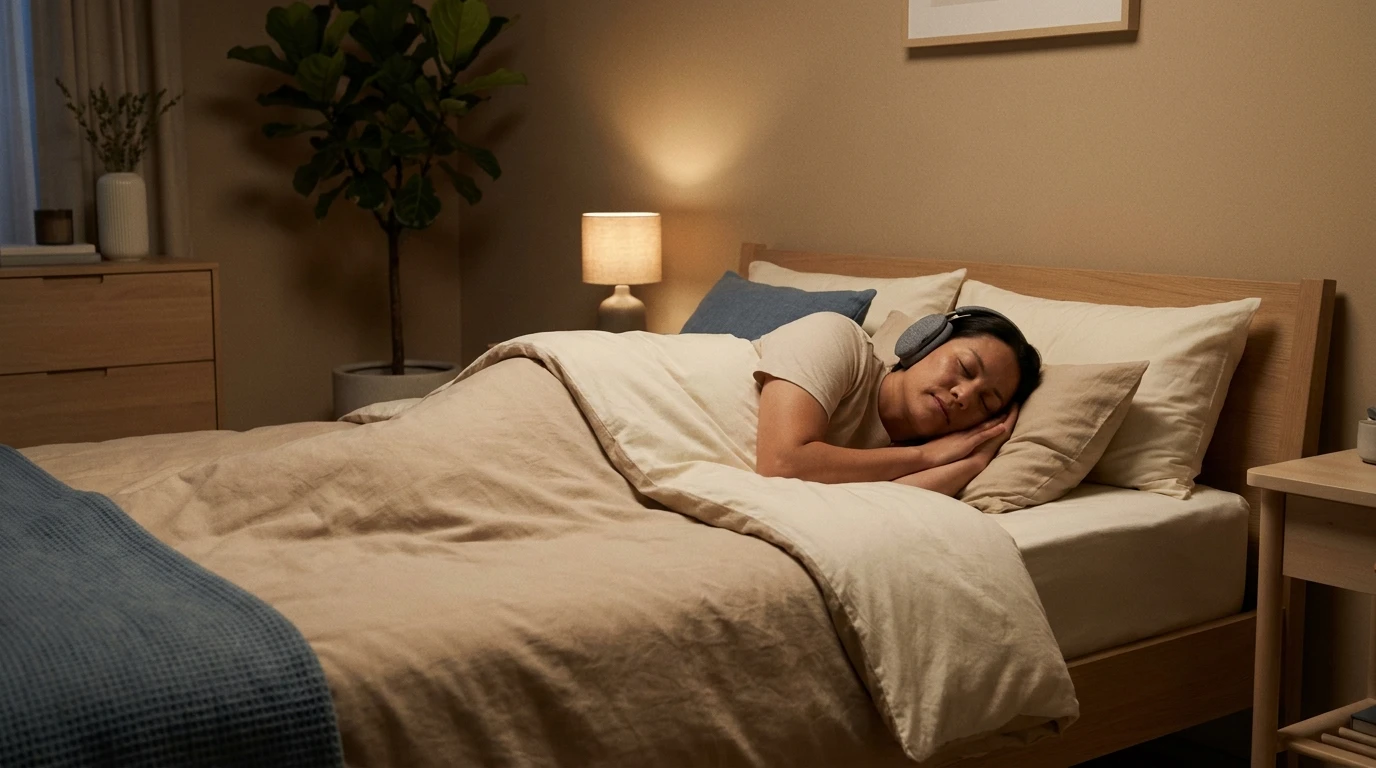
If you sleep alone, a small speaker on the nightstand is usually the simplest option: you turn it on, you have nothing to wear, and you can move freely all night. If you share the room with someone who sleeps differently — at a different volume, on a different schedule, or who simply prefers quiet — headphones make more sense: the sound stays yours alone and doesn’t impose anything on the other person. The downside of headphones is comfort: not every pair holds up well against a pillow all night if you’re a side sleeper, and the cord can get in the way if you move around. The downside of a speaker is that, if your partner doesn’t want that sound in the room, you have to work it out first. There’s no single right answer here — it depends on who you share the room with, not on which option is objectively better.
Start It Before You Lie Down, Not Once You’re Already Tossing and Turning
A common mistake is saving background sound as a last resort: you lie down, turn off the light, and only twenty minutes later, still awake, do you finally turn it on. The reverse order works better. If you start the sound environment a little before you get into bed — while you’re brushing your teeth, while you’re setting things out for tomorrow — by the time you lie down it’s already part of the room, not an emergency measure. Turning it on only once you’re uncomfortable ties it to the problem; turning it on earlier ties it to the routine of going to bed itself, which is a much better place for that sound to live.
The Timer: Should It Run All Night or Cut Off?
There are two reasonable approaches, and it’s worth trying both. Cutting the sound off after thirty or sixty minutes saves battery and avoids playing it all night for no reason, but it comes at a cost: if you wake up in the middle of the night — which happens to everyone now and then — and the background is gone, the new silence can feel just as noticeable as the noise it was covering. Leaving it on all night avoids that cutoff, though it means keeping the device plugged in or well charged. There’s no fixed rule: if you tend to wake up often in the early hours, it probably makes sense to leave it running; if you sleep straight through, a short timer is plenty. We go through that call in more detail in sleeping with sound in the background all night.
What Really Makes the Difference Is Repeating the Same Environment
Of all the decisions on this list, the one that matters most is also the simplest: using the same sound every night, not a different one depending on your mood that day. Repetition is half the job. A background that repeats night after night stops being something you actively listen to and becomes just another cue that it’s time to sleep, in the same category as putting on pajamas or turning off the light. If you keep switching sounds — waves one night, rain the next, generic white noise after that — you have to get used to it all over again each time. Picking one environment and sticking with it is, at its core, a matter of habit and comfort: there’s no magic combination of frequencies that beats another in the abstract, just the one you already know and that your body has come to associate with sleep.
We build Tonaleve’s nighttime sessions around several of these same ideas — the type of background, the gradual fade-out — and you can see that reasoning laid out in more detail on our methodology page. If you want to give it a try, you can build your sound profile and hear what a nighttime session sounds like right from your browser, at my.tonaleve.app, no install needed.
Frequently asked questions
- What sound is best for sleep?
- The one that covers what bothers you without drawing attention on its own. For low street rumble, brown or pink noise usually works better; for voices or a neighbor's TV, one with more presence in the midrange. The practical rule: if two minutes in you have forgotten it is playing, it is the right one.
- Should the sound run all night or be on a timer?
- It depends on which noises reach you and when. If what wakes you happens in the small hours (a garbage truck, a neighbor coming home late), a timer that shuts off after thirty minutes will not cover you. If the noise only bothers you as you fall asleep, a timer is enough and avoids sound you do not need.
- Could background sound keep me from hearing my alarm?
- At low volume, no: an alarm has far sharper peaks than an even noise and cuts through without trouble. If you are unsure, test it once while awake rather than trusting it blind on the first night.
Keep reading
A Ten-Minute Wind-Down Routine Before Bed
The problem is rarely the bed itself, it's what you're doing ten minutes before. A short, no-lecture routine to get into bed already halfway settled.

Background Sound for Focus, Without the Distraction
Why a nearby conversation breaks your focus far more than an air conditioner at the same volume, and how to pick a background that helps instead of stealing your attention.
Headphones for Nighttime Listening: What to Look For
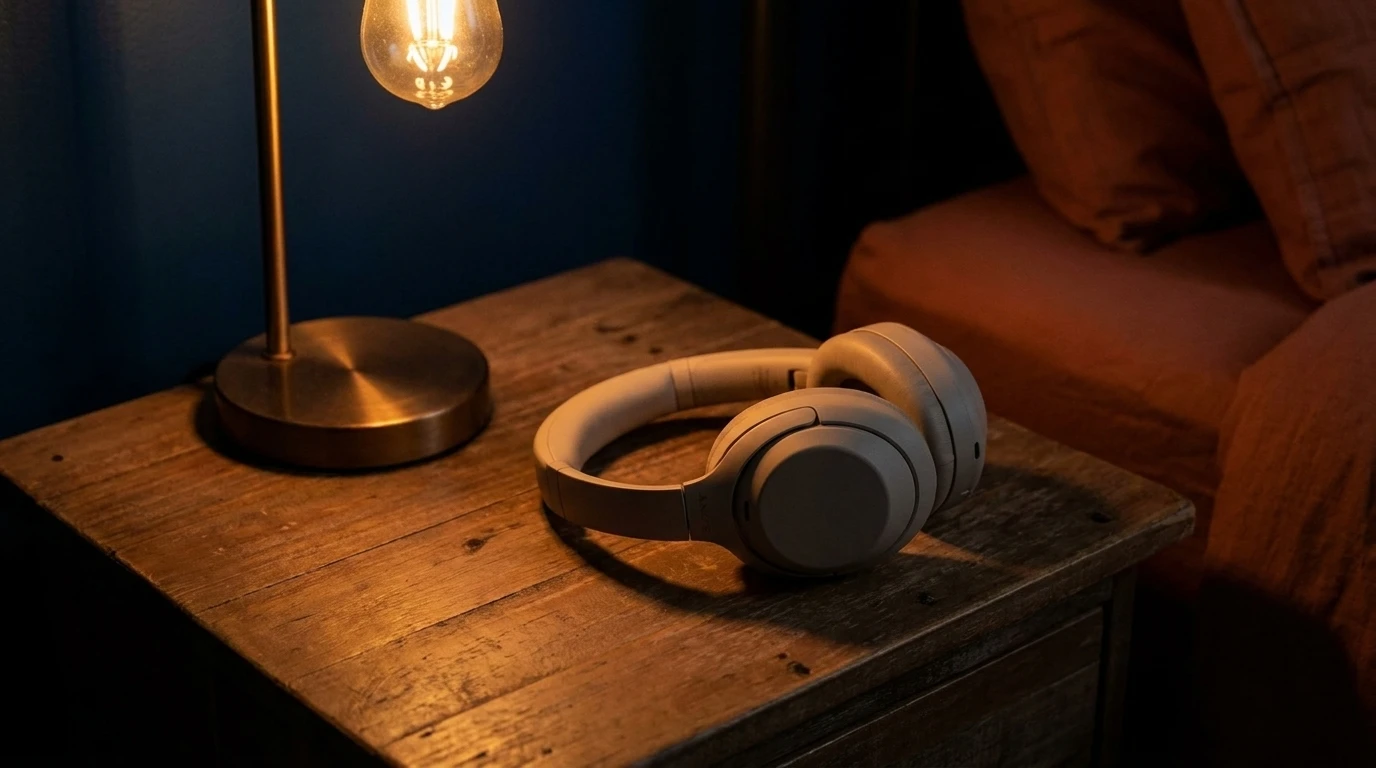
The same audio doesn't sound the same through two different headphones, and at night that matters even more. What to look for in fit, cable, and noise cancellation.