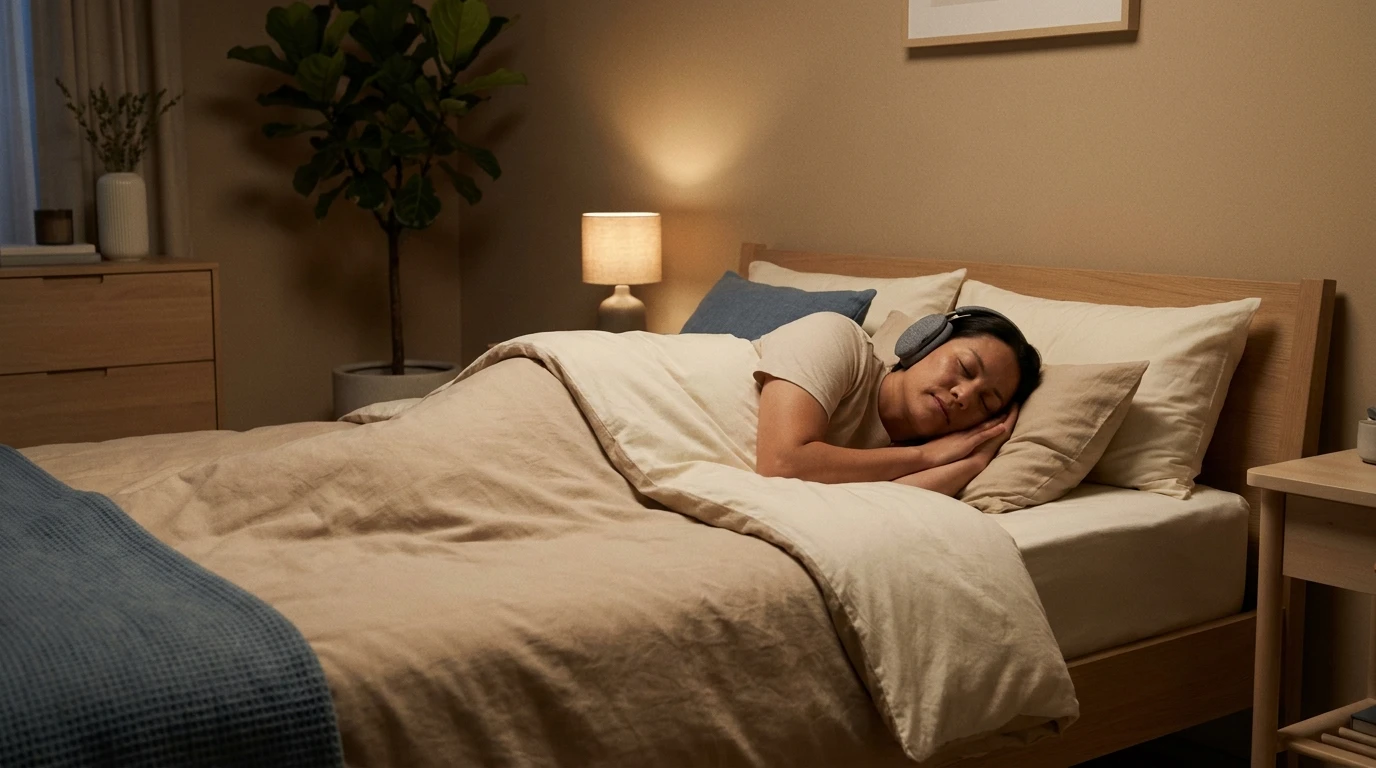
Should You Sleep With Sound All Night, or Turn It Off?
Leaving the sound on until morning and cutting it with a timer are not the same call, and the answer depends on when you wake up. Volume, headphones, and what to do at 3 a.m.
Last reviewed: September 19, 2026
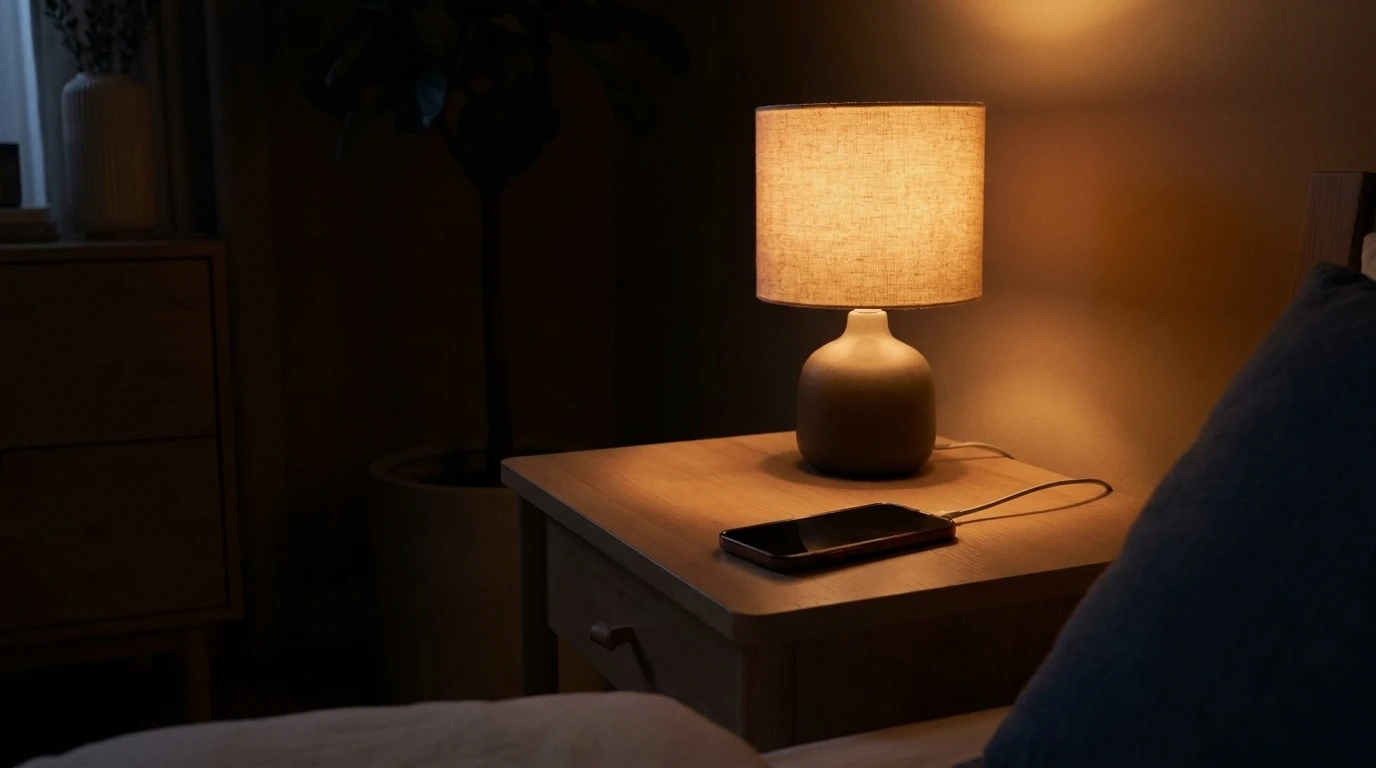
The question always shows up around the second or third week, once background sound has stopped being a novelty: is it fine to leave it playing all night, or should it shut itself off once you’re asleep? There’s no single answer, but there are a few criteria that let you decide without guessing your way through it.
What Happens When the Sound Keeps Playing and You’re Already Asleep
Sleeping doesn’t switch your hearing off. You keep registering what’s around you while you sleep — that’s why an alarm wakes you, and why a slammed door does — and having background sound on doesn’t change that. What changes is what there is to register. An even sound, with no peaks and no events, gives you nothing new to react to: it becomes part of the room, like the hum of an air conditioner you stopped noticing a long time ago. The issue usually isn’t the duration but the kind of sound. A playlist that ends one track and starts another, a storm recording with thunderclaps, an app that drops a two-second gap every time the loop comes back around — all of that creates moments, and moments in the middle of the night are exactly what you don’t want. If the background is continuous and seamless, running for eight hours doesn’t make it any more intrusive than running for thirty minutes.
A Timer Solves Part of the Problem and Creates Another
Cutting the sound off after thirty or sixty minutes has real advantages: it saves battery, it keeps a speaker from playing all night in a shared room, and it frees up the device. The catch is that the shutdown itself is an event. If the timer cuts out abruptly at one in the morning, what appears isn’t “nothing”: it’s the silence of the room, which at that hour runs deeper than when you went to bed, and with it everything the background had been covering. Plenty of people who swear the sound “doesn’t work” for them are actually waking up right after the cutoff. If your app offers a gradual fade instead of a hard stop, that’s the good version of the timer: the background thins out little by little and there’s no single moment where something disappears. And if it doesn’t, the question to answer is simple — do you wake up in the small hours, or do you sleep straight through? A short timer suits the person who sleeps through. Anyone who opens their eyes at four is better off with the sound still there.
The Volume at 3 a.m. Isn’t the Volume at 11 p.m.
This is the adjustment most people skip. When you go to bed, the room still has background noise: the street, the neighbor’s TV, someone still moving around the house. Three hours later, all of that has dropped away. The sound you set didn’t get louder, but the floor it sits against did get quieter, which is why the same level can feel distinctly louder at 3 a.m. than it did when you chose it. The practical consequence is to calibrate for the quietest stretch of the night rather than the noisiest one, and that almost always means leaving it lower than you’d pick at eleven. We’ve written separately about what “low” means in concrete terms, in what volume to listen at. And there’s one pattern worth keeping an eye on: if you need it a notch louder every night than the night before, that doesn’t get fixed by turning it up. It gets fixed by coming back down for a few days and starting over from the bottom.
If You Wake Up at Three in the Morning
Waking up in the small hours happens to everyone; what decides how the rest of the night goes is what you do in the next two minutes. The version that makes things worse is grabbing the phone, checking the time, opening the app, switching sounds, turning it up, trying another one. That turns a brief wake-up into an active listening session with a lit screen, and from there falling back asleep takes considerably longer. The version that works is deliberately boring: if the sound is playing, leave it exactly as it is. If it had shut off, turn it back on without lighting up the screen — with a widget, a physical button, or a lock-screen shortcut you set up in advance — and don’t touch the volume. This isn’t willpower, it’s preparation: how that 3 a.m. goes is decided at eleven at night, by leaving everything ready so there’s nothing to decide later.
Headphones or Speaker When the Sound Is Going to Run for Eight Hours
Wearing headphones for half an hour to fall asleep and wearing them all night are two different things. Eight hours with your ear pressed into the pillow under an earcup makes itself felt; in-ear models can turn uncomfortable as the hours add up, and the cable ends up wrapped around something. If you sleep alone, a speaker is usually the simpler option for a full night and the one that asks the least of you. If you share the room, headphones still make sense, but the format matters more than it seems: what holds up overnight isn’t the same as what sounds good during the day. We go into that in headphones for nighttime. One small but real consideration: if the device is going to play until morning, leave it plugged in, and if it also happens to be your alarm, test once while you’re awake that the alarm comes through over the background.
Why Absolute Silence Sometimes Makes the Ringing Worse
It sounds contradictory, but it follows from how listening works. What kept the ringing in the background during the day was the noise of everything else: voices, traffic, the fridge, a fan. In a perfectly silent room none of that is left, and the ringing has the stage to itself. On top of that, the more it stands out, the more attention it takes, and attention keeps it in the foreground — a loop that feeds itself right when you’re trying to fall asleep. That’s why a lot of people find a room with a soft background easier to be in than a completely quiet one, not because the sound “does” anything but because total silence is the worst possible listening condition for something you’d rather not notice. That logic is laid out in more detail in why the silence of the night feels louder.
How to Settle It Without Spending a Month on It
The honest way to resolve this is to try a week of each, changing nothing else: one week with the sound on all night, the next with a timer, same sound and same volume for both. And judge by the morning, not by the night — what we remember of the small hours is thin and unreliable, while how you feel getting up and how many wake-ups you can recall are far more useful signals. The result is usually fairly clear after those fourteen days, and it doesn’t always match what you expected going in.
Tonaleve’s nighttime sessions are built around several of these same criteria — a continuous background, a gradual fade-out, a volume calibrated to you — and the full reasoning is on our methodology page. If you’d like to try it, you can build your sound profile and hear what a nighttime session sounds like right from your browser, at my.tonaleve.app, no install needed.
Frequently asked questions
- Is it bad to sleep with noise in the background?
- There is nothing inherently bad about letting it run until morning: it is a comfort choice. What is worth watching is the volume — low and even — and that the sound has no events or cutoffs. If you notice you need it a little louder every night, that is the moment to step back down rather than keep climbing.
- Should I leave white noise on all night or use a timer?
- It depends on whether you wake in the small hours. If you sleep straight through, a timer is plenty and saves battery. If you wake at three or five, the cutoff works against you: you meet a brand-new silence at the quietest point of the night.
- What is that noise you hear at night?
- Almost always the same sounds that were already there — the fridge, a pipe, distant traffic — which the general daytime noise was covering and the night no longer does. If instead it is a constant ringing only you can hear, that belongs in another category and it is worth reading [what tinnitus is](/en/news/what-is-tinnitus/) first.
- How loud should background noise be at night?
- At the level that works at four in the morning, not the one that feels right at eleven at night. Since the room keeps getting quieter, a level that feels comfortable at bedtime can read as loud in the small hours. Set it low and leave it alone.
- Why does silence at night make the ringing worse?
- Because what was covering it was the background noise, and in a completely silent room there is nothing left to cover it. It is not that silence does harm: it is the least favorable listening condition for something you would rather not notice.
Keep reading

How to Build a Sound Environment for Sleep
Before you pick a background sound for sleep, it helps to notice which noises actually reach your bedroom and when. Here's how to build that environment, step by step.
A Ten-Minute Wind-Down Routine Before Bed
The problem is rarely the bed itself, it's what you're doing ten minutes before. A short, no-lecture routine to get into bed already halfway settled.

Background Sound for Focus, Without the Distraction
Why a nearby conversation breaks your focus far more than an air conditioner at the same volume, and how to pick a background that helps instead of stealing your attention.