Tinnitus and Anxiety: Why Stress Makes the Ringing Louder
During tense weeks or after a few short nights, the ringing seems louder even though nothing changed. Here's why that happens, what to do with your sound environment, and when to see someone.
Last reviewed: September 22, 2026

There’s an experience that comes up constantly and almost never gets said out loud: you go through a few calm weeks and the ringing fades into the background, barely a detail; then a hard stretch arrives — a move, a deadline, a family problem, several nights of bad sleep — and suddenly the ringing is everywhere. It seems louder, it shows up at any hour, and ignoring it takes far more effort than it used to. The feeling that it “got worse” is entirely real, even though what changed usually isn’t the sound.
What Stress Actually Has to Do With the Ringing
It’s worth being honest about what can and can’t be claimed here. That sound you hear and no one else does — tinnitus — can have very different causes, and figuring out which one is yours is a professional’s job, not an article’s. What does show up again and again, and you’ve probably noticed it yourself without anyone explaining it, is that high-tension stretches and tinnitus travel together: during the hard weeks it becomes more present and more bothersome, and when things settle it tends to slide back into place.
The distinction that helps most is the one between how loud it is and how much room it takes up. Those are two different things and they don’t move together. Two people with practically identical ringing can live with it in opposite ways: one has it there, in the background, and gets on with the day; the other can’t think about anything else. And the same person, with the same ringing as always, experiences it differently on a vacation week than on a week of deadlines. Nearly everything that changes between those two situations belongs to the second category: the space that sound occupies in your attention.
The Attention Loop: the More You Check, the More You Find
When something worries you, a quiet and hard-to-notice habit sets in: every so often you go check whether the ringing is still there. A silent moment at the office, a red light, the minute before falling asleep — without deciding to, you run a kind of internal scan. The trouble is that the scan isn’t neutral: to confirm it’s there you have to go looking for it, and looking for it is exactly what pulls it to the front. Every check confirms it’s still around, and that confirmation reinforces the idea that it matters and needs to be monitored.
That loop sustains itself and has nothing to do with willpower. The way out isn’t “stop thinking about it” either, which is an impossible instruction to follow. What tends to work better is giving your hearing something else to do — a soft background sound, an activity with a sound of its own — and lowering the urgency of the check: you don’t have to win against it, it’s enough to stop feeding it every ten minutes.
Why It Spikes at Night and in Quiet Moments
The other half of the story has nothing to do with you and everything to do with the room. During the day there’s a constant noise floor — traffic, people, the fridge, a conversation somewhere — that naturally covers the fainter sounds. At night that floor collapses, and what used to sit below it now stands above. On top of that, lying down in the dark, nothing is left to compete for your attention. The two things that kept the ringing in the background — the noise around you and your own occupied attention — pull back at the same time. We go into it separately in why the silence of the night feels louder, because understanding it changes how you approach the small hours.
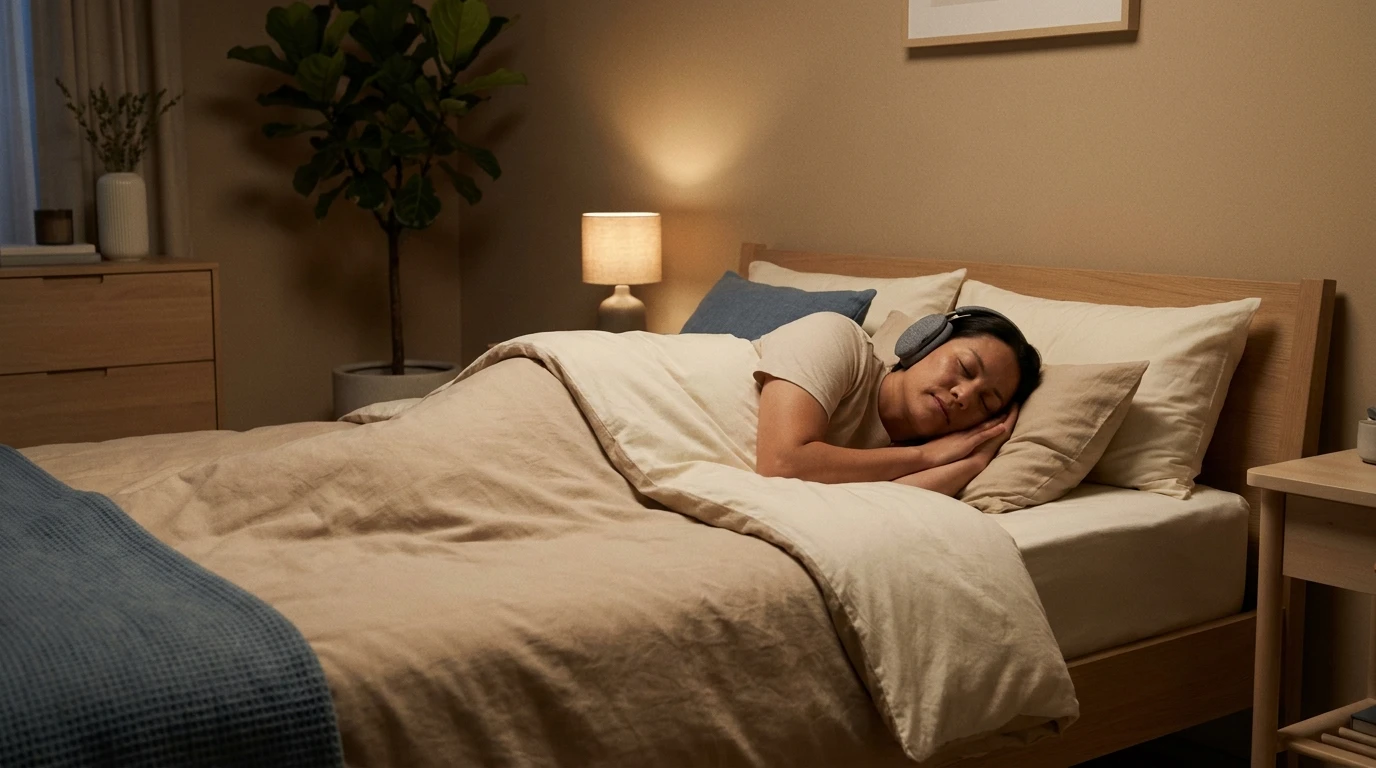
This is where stress and nighttime compound each other. Tense weeks usually bring fewer hours of sleep, more tossing before falling asleep, and more waking up at three in the morning. Every one of those stretches awake is a stretch spent in silence, with nothing to do and a busy mind: the worst possible context for a sound you’d rather not hear. And the next day, on less rest, tolerance for any kind of discomfort drops. The ringing didn’t grow — it just found you with less margin.
What to Do With Your Sound Environment When It Spikes
When the ringing takes over, the most common impulse is the one that works worst: turning something up until it’s buried. That leaves two loud sounds competing for your attention instead of one, the result is generally worse than where you started, and the next day it takes a little more. The idea that actually pays off is the opposite: a soft, even background with no sudden peaks, set at a level where the ringing is still faintly audible if you go looking for it. That’s the difference between masking and covering up, laid out in masking is not covering up, and for what “soft” means in concrete terms we wrote what volume to listen at.
Two small details help more than they look like they would. The first is consistency: use the same background every day instead of switching sounds every time the ringing bothers you, because switching is another form of checking. The second is timing: start the sound before you get into bed, as part of the routine, rather than twenty minutes in when you’re already restless and the sound gets tied to the discomfort. On tense days it’s also worth deciding in advance whether the background runs all night or stops on a timer, a call with two sides that we look at in sleeping with sound in the background all night.
When It’s Time to See a Professional
None of the above replaces a consultation, and there are situations that call for going straight to an ENT or an audiologist: if the ringing came on suddenly, especially alongside a sudden drop in hearing; if it’s persistently in only one ear; if it pulses along with your heartbeat; if it comes with dizziness, vertigo, pain, or discharge; or if it started after a blow to the head or after beginning a new medication. Being in a stressful period doesn’t rule any of those out, so it’s better not to pin everything on nerves without having someone look properly.
There’s a second kind of consultation that gets mentioned far less and is just as valid. If anxiety, mood, or insomnia have become the main problem — if the ringing is costing you sleep, making it hard to concentrate, or causing sustained distress — a mental health professional has concrete tools for exactly that, and in many cases working on that side is what most changes daily life with the sound. Asking for help there isn’t an overreaction: it’s going where the real weight of the problem sits.
What You Can Do Today
In the meantime, your sound environment is what’s within reach and can be adjusted today. At Tonaleve we build a personal sound profile: the app walks you through identifying the character and approximate frequency of what you hear, measures a comfortable level for you, and generates a background designed to accompany rather than compete. Worth spelling out: that calibration is an internal reference for adjusting audio, not a clinical measurement and not a diagnosis, and it doesn’t replace a professional evaluation. The full protocol is published on our methodology page.
If you’d like to hear what a background built around your own tone sounds like, you can create your profile in a few minutes from the browser, no install needed, at my.tonaleve.app.
Frequently asked questions
- Can stress and anxiety cause tinnitus?
- What shows up most clearly is that during stretches of high tension the ringing becomes more noticeable and more bothersome, not necessarily louder. Whether stress is a cause, a consequence, or both in your particular case is something only a professional can assess: this article doesn't diagnose anything.
- Why is my tinnitus worse when I'm stressed?
- Mostly because stress changes where your attention goes and how much sleep you get. When you're on alert, your hearing keeps scanning the room and any faint sound moves to the front. Add fewer hours of sleep and more time awake in a silent house, and you get the two conditions where it stands out the most.
- Why do I hear ringing in my ears when I'm anxious?
- Anxiety turns up the checking habit: every few minutes something in you goes to verify whether the sound is still there. The catch is that checking requires looking for it, and looking for it is exactly what brings it to the foreground.
- Does stress-related tinnitus go away on its own?
- It often recedes once the tension eases or sleep recovers, and it stops occupying the center of the stage. If it persists, came on suddenly, affects only one ear, or comes with dizziness or hearing loss, that warrants seeing an ENT without delay.
- Why does tinnitus get worse at night?
- Because the background noise that covered it during the day drops away, and lying in the dark there's almost nothing else competing for your attention. The ringing didn't grow: it was simply left alone on stage.
Keep reading

That Ringing Only You Can Hear Has a Name: Tinnitus
If you hear a ringing, a hiss or a buzz that nobody else does, you're not making it up and you're not losing your mind. It's called tinnitus, it's very common, and there are concrete things you can do.

Hz, dB and dB SL, Explained Without the Math
Three words that come up constantly when people talk about sound, explained with everyday examples and no formulas, so you know what's shaping your sound profile.
What Volume to Play Background Sound At
The volume of your background sound matters as much as the sound itself. Why it pays to look for the lowest level that works, not the highest.